Who invented the radio? Popov, Marconi or Tesla?
Radio: A puzzle pieced together by many geniuses
In the history of science, few questions are as electrifying as the one about the „father of radio.“ Depending on where you studied, the answer is different. But if we put aside political biases, the truth turns out to be much more complex and interesting – radio is not the work of one person, but an evolution of ideas. It is not an „instantaneous“ discovery, but rather the culmination of a series of discoveries by different people at the same time.
Alexander Popov: The Pragmatic Scientist
On May 7, 1895, Alexander Popov demonstrated to the Russian Physico-Chemical Society the world’s first radio receiver, equipped with an antenna and a coherer with automatic recovery. Popov’s contribution was fundamental, because he transformed Hertz’s theoretical waves into a working device.
- Why he’s important: He created the first system that responded to electromagnetic signals in real time.
- Context: Working for the Russian Navy under strict secrecy, he was slow to patent, which cost him official recognition in the West.
Guglielmo Marconi: The Visionary Entrepreneur
The Italian Marconi was the man who „took“ radio out of the labs and sent it across the ocean. In 1896, he received the first patent for wireless telegraphy.
- Why he’s important: Marconi had a brilliant business acumen. In 1896, he received the first patent for „wireless telegraphy.“ He succeeded in sending a signal across the Atlantic (1901) and proved that radio could be used for global communication and was not just a laboratory experiment.
- Context: Although he used ideas from his predecessors, without his energy the technology would have developed much more slowly. Many of his early patents were based on the work of others (Hertz, Lodge, Tesla). In 1943, the US Supreme Court even invalidated some of his patents in favor of Tesla.
Nikola Tesla: The Theoretical Giant
Tesla is the man whose contributions are often overshadowed by his more eccentric ideas. But at the heart of every modern radio are his „resonant circuits“ (tuning to a specific frequency). Today his contributions are considered fundamental.
- Why he’s important: As early as 1893, he demonstrated the principles of radio and used resonant circuits (tuning to a specific frequency)—something without which radio today is impossible. In 1943, the U.S. Supreme Court invalidated key Marconi patents, recognizing them as Tesla’s work.
- Context: Tesla saw much further than simple telegraphy—he dreamed of wireless transmission of energy and information around the world. His ideas were so far-reaching that they often remained misunderstood or unfinished.
The Objective Verdict
Can we name just one? It’s not fair. To be completely impartial, radio is a collective creation in which everyone had a role:
- James Clark Maxwell predicted it mathematically.
- Heinrich Hertz proved the existence of waves.
- Alexander Popov created the first effective receiver.
- Nikola Tesla gave the concept of resonance and tuning.
- Guglielmo Marconi connected all this into a working commercial system and made it available to the world.
The Conclusion
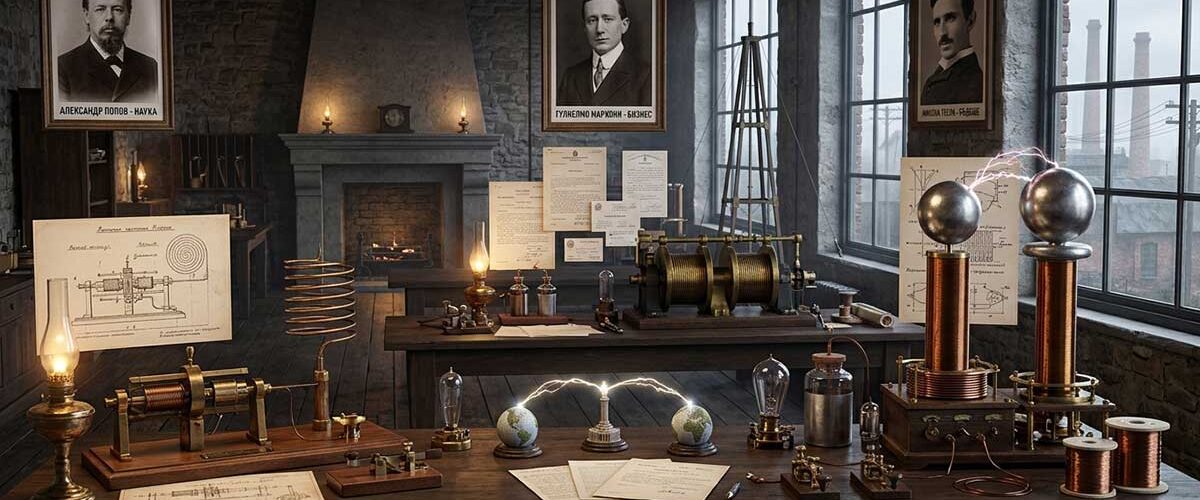
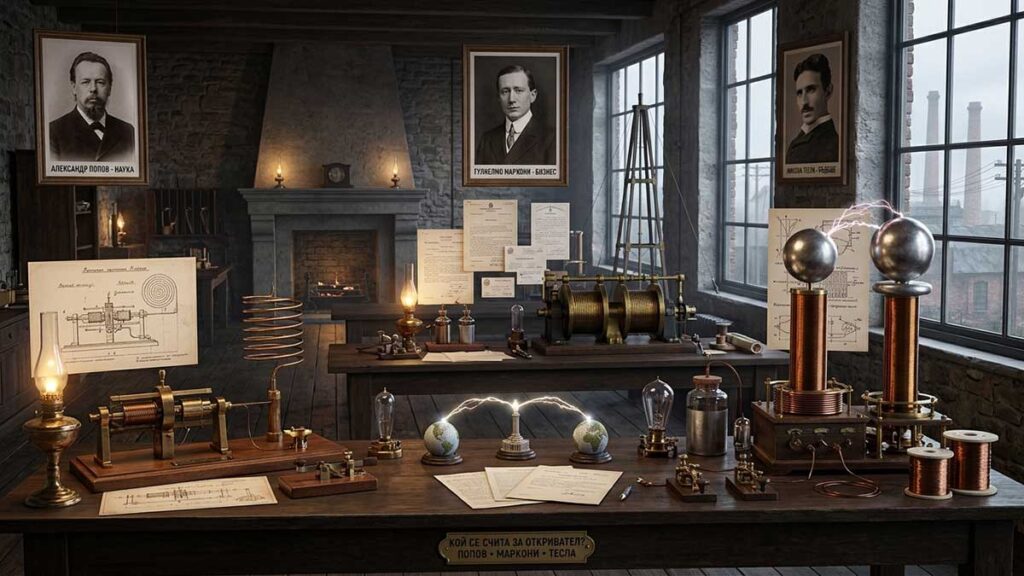
Popov is the discoverer of science, Marconi – of business, and Tesla – of the future.
All three deserve their place in the Pantheon of Technology.
Bibliography and recommended sources:
-
Marconi, G. (1897). Improvements in Transmitting Electrical Impulses and Signals, and in Apparatus therefor. British Patent No. 12,039. (Marconi’s official patent).
-
Tesla, N. (1919). My Inventions: The Autobiography of Nikola Tesla. Electrical Experimenter magazine. (Tesla’s personal memoirs where he describes his ideas for wireless transmission).
-
Popov, A. S. (1896). Relation of metal powders to electrical oscillations. Journal of the Russian Physical and Chemical Society (ZRFHO). (The publication describing his „ugly flag“ – the first receiver).
-
U.S. Supreme Court (1943). Marconi Wireless Tel. Co. v. United States, 320 U.S. 1. (The U.S. Supreme Court decision that recognized the priority of Tesla’s patents over Marconi’s.)
-
Lodge, O. J. (1894). The Work of Hertz and Some of His Successors. London: „The Electrician“ Printing and Publishing Company. (An important source for the development of the coherer, used by both Popov and Marconi).
-
Süsskind, C. (1962). Popov and the Beginnings of Radiotelegraphy. Proceedings of the IRE. (One of the most objective Western studies of Popov’s contributions).
-
Aitken, Hugh G. J. (1985). The Continuous Wave: Technology and American Radio, 1900-1932. Princeton University Press. (A classic work on the technological evolution of radio).