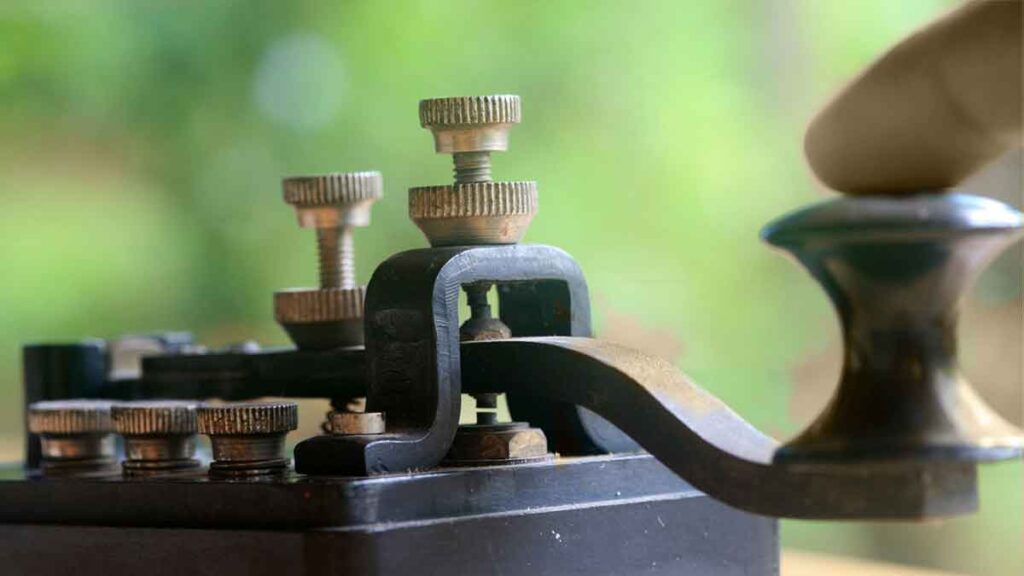
The Art of CW (Telegraphy)
Introduction to Morse Code and On-Air Practice
Morse code is a text transmission method utilizing sequences of short and long audio tones. In amateur radio operating, these tones are articulated rhythmically as DIT (short signal) and DAH (long signal, 3 times the duration of a DIT).
1. Auditory vs. Visual Perception
While often described as „dots“ and „dashes“, this stems from 19th-century paper-tape recording telegraphs. Modern operators perceive characters entirely by sound.
- The letter R is not „dot-dash-dot“ or
.-., but rather the acoustic melody DIT-DAH-DIT. - A final short tone is sometimes pronounced as DIT to indicate character completion, but the core building blocks remain DIT and DAH.
The term CW stands for Continuous Wave, which is interrupted in the rhythm of Morse code. In amateur radio terminology, „CW“ and „Morse code“ are used interchangeably.
2. Advantages of CW over Voice (SSB)
Bandwidth Efficiency: The bandwidth (at -6 dB) of a properly shaped CW signal is approximately 4 times the keying speed in WPM (Words Per Minute).Example: A CW signal transmitted at 25 WPM occupies only 100 Hz of bandwidth. By comparison, a standard SSB voice signal requires roughly 2.7 kHz (2700 Hz) – enough spectrum to fit dozens of CW signals!
Why CW Excels in Weak-Signal DXing
- Superior Signal-to-Noise Ratio (S/N): Due to its narrow bandwidth, a CW signal captures far less background noise than SSB.
- Human Ear Processing: The trained human brain acts as an exceptionally selective audio filter, copying weak CW signals buried deep in the noise floor where voice communication is impossible (e.g., 160m or EME/Moonbounce).
3. Operating Speeds and Benchmarks
Morse code operating speed is measured in WPM (Words Per Minute) or characters per minute (CPM):
| Speed | Practical Application |
|---|---|
| 5 WPM (25 CPM) |
Entry level. Mainly used on designated QRS frequencies (slow-speed centers defined in the IARU band plan). |
| 12 WPM (60 CPM) |
The practical minimum for maintaining routine independent contacts. |
| 20 – 30+ WPM (100 – 150+ CPM) |
Standard operating speed for experienced CW operators, contest stations, and DXers. |
There is no secret recipe to mastering Morse code – success comes entirely down to consistent practice and auditory training. CW remains a universal language spoken by operators worldwide!