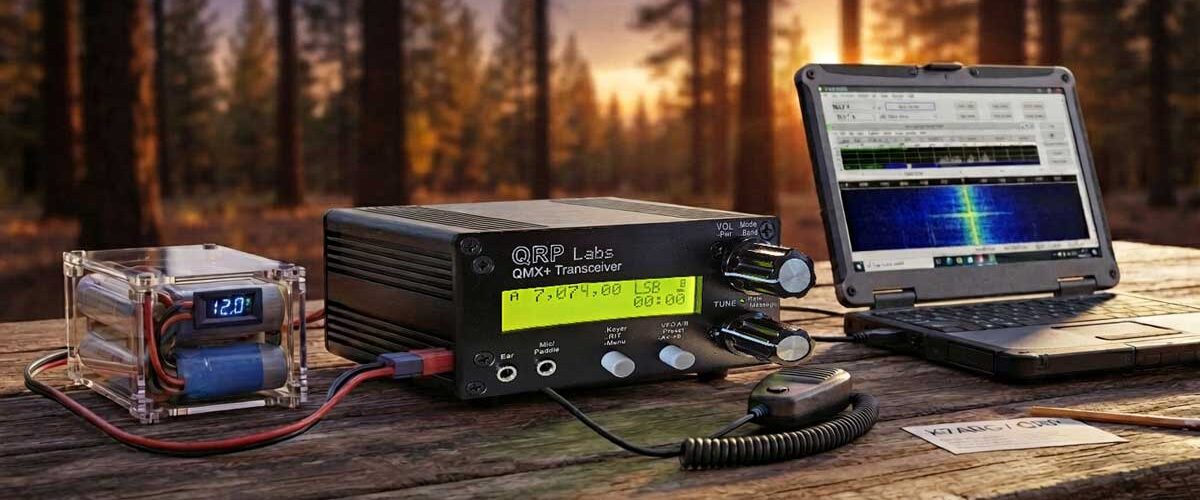
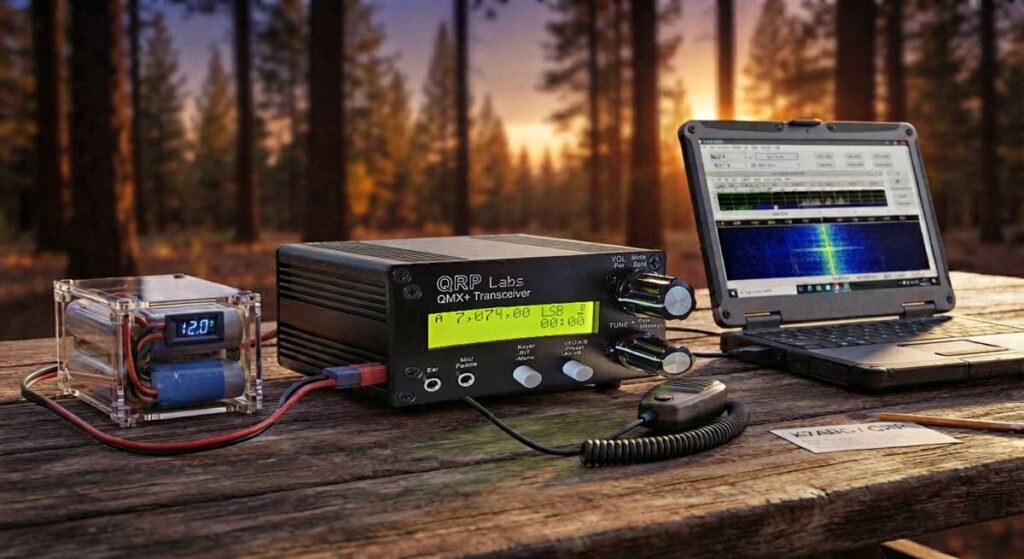
QMX+ from QRP Labs: The Small Giant in QRP (160m – 6m)
If you have ever dreamed of gathering the entire amateur radio world from 160 meters all the way to 6 meters (the magical range) in a sandwich-sized box weighing about as much as a pair of kebabs... I have good news for you! As a happy owner of QMX+ at QRP Labs, today I am pleased to tell you about this little technical monster.
Forget about heavy 10-kilogram transceivers that make you go to a physiotherapist after every trip to a Vitosha peak. QMX+ is designed for a true QRP adventure – without compromises in receiver quality and without unnecessary cables!
🚀 How did the QMX+ shake up the QRP world?
- 12 amateur radio bands: From the longest 160m to the ultra-high 6m (including 6m!).
- Complete SDR Receiver: 24-bit 112dB stereo ADC for crystal clear sound.
- Only 1 USB-C cable: Built-in 24-bit 48ksps sound card and CAT control. No cables, no external sound cards!
- Operating modes: CW, SSB (USB/LSB), Digi (FT8, JS8Call, RTTY) and WSPR.
- Low consumption: Small, lightweight, and with barely 80mA on receive and less than an amp on transmit – ideal for SOTA and POTA activations!
📡 The Magic Inside: Pocket-Sized SDR Technology
How did the developers manage to cram 12 scopes into a box the size of 106 x 55 x 146 mmWith a lot of passion, tin, sleepless nights, and brutal digital signal processing (DSP)!
The heart of QMX+ uses a powerful Si5351A VFO synthesizer with tuning down to 1 Hz and a built-in 25MHz TCXO (temperature-compensated crystal oscillator) for perfect stability. Transmission is so clean that the unwanted sideband and residual carrier frequency are literally reduced to zero. This means all of your 3 to 5 W of output power go right where it needs to be – on the air, rather than as a nuisance to the neighbors!
📊 Main Technical Parameters
| Parameter | Specification |
|---|---|
| Frequency range | 12 bands: 160m, 80m, 60m, 40m, 30m, 20m, 17m, 15m, 12m, 11m, 10m and 6m |
| Output power | 3 – 5W QRP (adjustable for 9V or 12V power supply) |
| Operating modes | CW, SSB (LSB/USB), Digi (FT8, JS8Call), WSPR |
| Receiver | Built-in SDR with 24-bit 112dB stereo ADC |
| Communication with PC | USB-C (Built-in 24-bit 48ksps sound card + virtual COM port for CAT) |
| Power consumption | RX: ~80mA | TX: ~0.7A (at 12V/5W) or 1.0-1.1A (at 9V/5W) |
| Display and case | 16x2 LCD with yellow/green backlight, black aluminum case |
🎛️ Anatomy of the QMX+: Front and Rear Panel
The design is conceived by radio amateurs for radio amateurs. Everything is arranged ergonomically and logically:
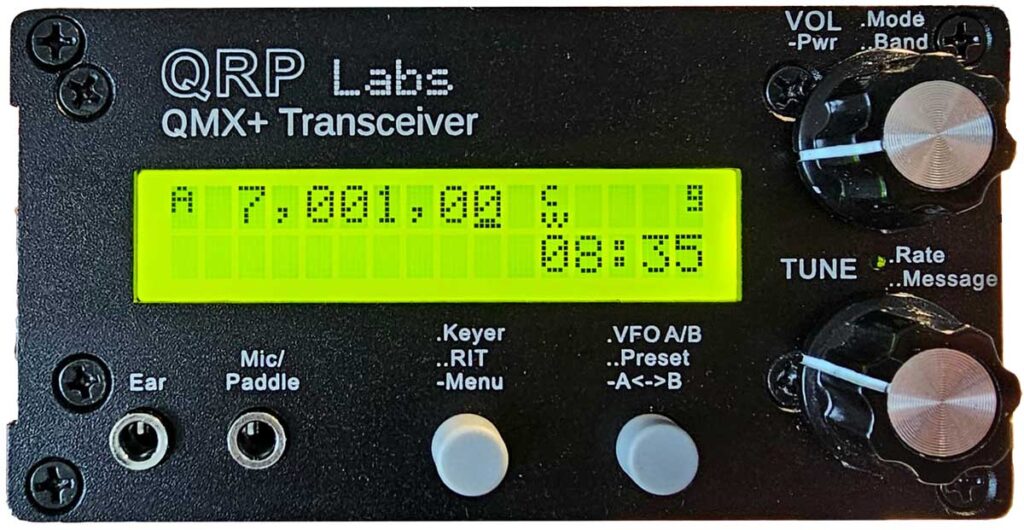
Front panel: 16×2 LCD display, rotary encoders, headphone jacks, and a Morse paddle/straight key.
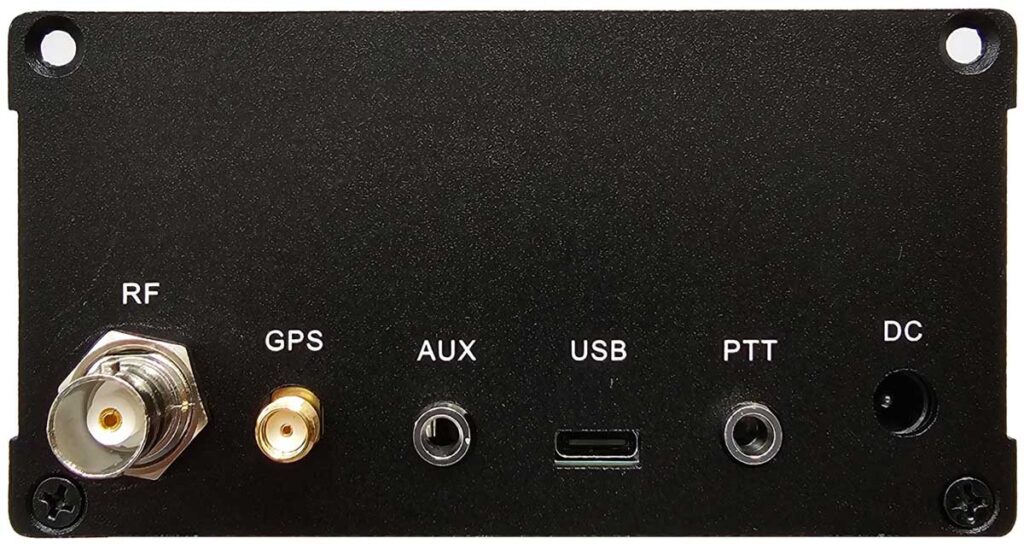
Back panel: BNC antenna input, GPS SMA, AUX/CAT, USB-C port for audio+control, PTT and DC 2.1mm power supply.
🛠️ Firmware Arsenal (latest update)
The QMX+ firmware is constantly evolving, and its features prove that size doesn't matter:
- Built-in CW decoder: Decode Morse code in real-time directly on the LCD screen! Perfect for beginners. However, I recommend enrolling in a course for radio amateurs and learning CW.
- 200Hz CW filter: Crystal filter without annoying ringing to catch even the weakest signals in the pile-up.
- Built-in test equipment: The QMX+ is not just a radio – it is a laboratory! It features a built-in RF power meter, voltmeter, frequency counter, and test signal generator.
- VSWR protection: Built-in SWR meter with automatic indication and protection to prevent burning out the final transistors with a bad antenna. It recovers a bit sluggishly, but if they burn out, it will certainly be slower.
- GPS module (QLG3 option): Automatically calibrates frequency, real-time clock (RTC), and location (Grid Square) for flawless operation as a standalone WSPR beacon!
- Expansion slot: There is an optional developer PCB to integrate things like a battery pack or a small power amplifier with a speaker inside (despite its small size, there is room).
💡 Tip: Working in nature:
To get the maximum clean reception without radio interference (QRM), power the QMX+ with 3S 18650 battery pack with linear regulation. Switching power supplies and cheap power banks often introduce noise into the SDR receiver. With the „clean“ battery = you hear even the quietest DX!
🔗 Useful Links and Bibliography
Do you want to learn more or order a DIY kit? Here are the official sources:
- QMX+ Official Page at QRP Labs - Detailed assembly guides and schematic.
- QRP Labs Official Groups.io Community – The place for questions, support, and new firmwares.
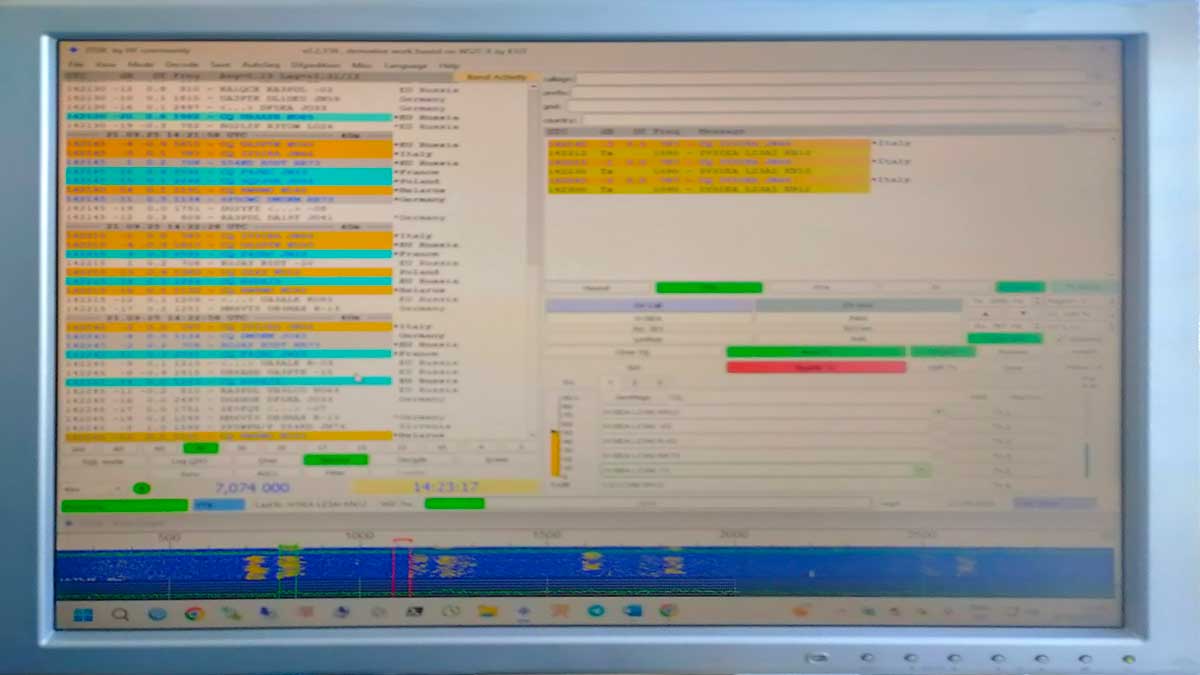
- WSJT-X (K1JT) software – Free software for FT8 / WSPR operation with your QMX+.
- Read also: The complete list of Q-codes on our blog – Become a master of on-air abbreviations!
Are you ready to conquer the airwaves with 5 Watts?
Assembling the QMX+ is a great adventure for any radio amateur.
We'll hear from you on the bands, right?
73 & Best DX! 📡✨