Despite the fact that I was born in Sofia in 1943, my family moved to Tarnovo at that time.
After 1965, Tarnovo received its real name Veliko Tarnovo, due to its greatness as the capital of the Second Bulgarian Kingdom.
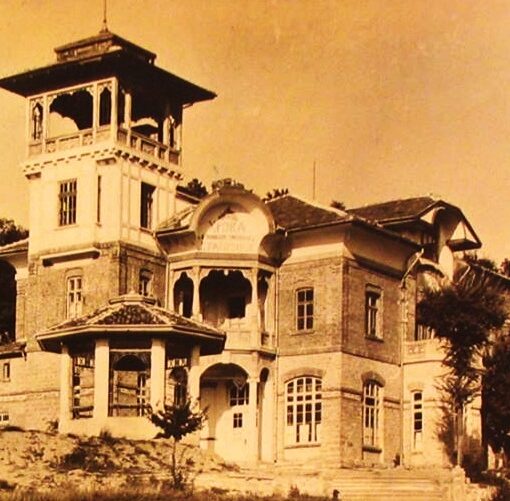
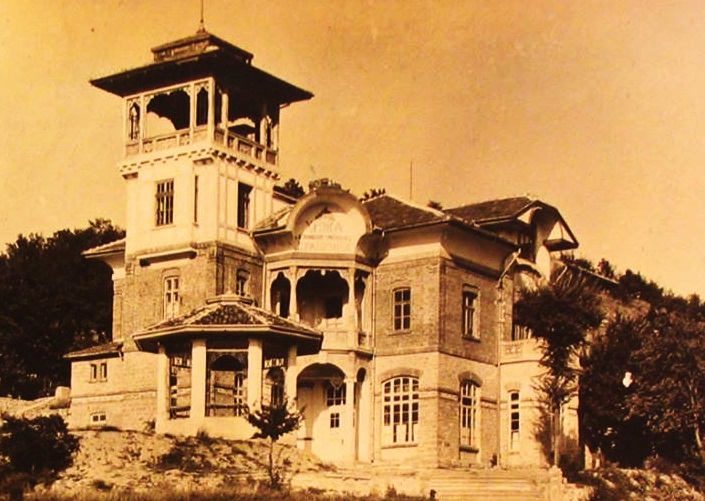
My family lived in my grandfather’s house, which was on the site of the northern wing of the Interhotel Veliko Tarnovo.
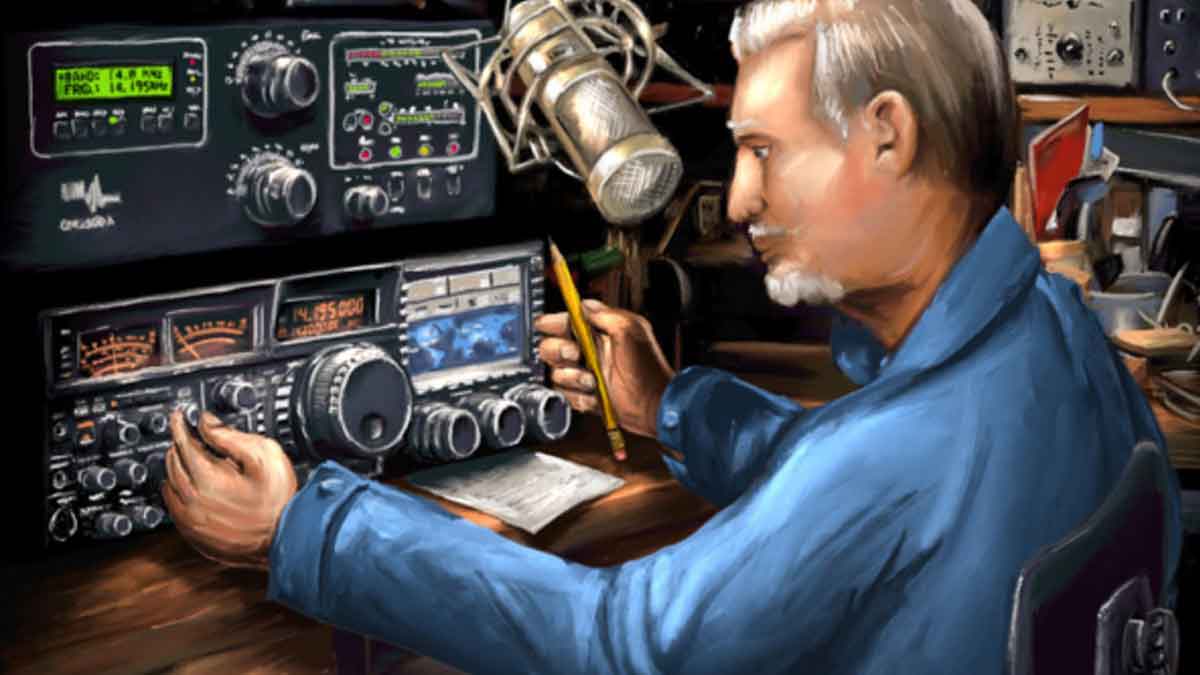
My first steps in amateur radio were in this house.
My father, Stoyan Zayakov, despite being a high school teacher, was very interested in radio and constantly subscribed to the magazine „Radio“. Thinking back on those years, I think what I read in the magazine made me start to become more and more interested in radio. It’s not about amateur radio at all, but about radio. Seeing my interest in radio, one of my aunts gave me a radio tube (6K7) with which I was able to make my first receiver.
At that time, my same aunt had started working at the Palace of Pioneers, which was located on Tsarevets.
In 1956, the first group for training telegraphers and, of course, radio amateurs was formed at the Palace.
When my aunt told me, I signed up without thinking. Siika Yancheva taught us, who managed to prepare us for the first radio connection. We knew Morse code, code abbreviations, how the initials and prefixes of many European countries are formed.
Nikolay Pisarov and I graduated as the top students in the group. We were allowed to make our first contacts on the air, which happened on 07.01.1957.
In order to progress faster with the study of the Morse code, and also to learn to transmit with a manual key, I had initially made myself a 50Hz buzzer with an electromagnet and a metal plate, and later a Morse code generator from a telephone receiver, microphone and battery.
While our training was going on, we often passed by the radio club of Tarnovo, but I personally did not dare to enter.
It seemed to me that there were only great radio amateurs inside, whose capabilities I wanted to reach as soon as possible.
To our joy with Nikolay Pisarov, at that time he had met Boncho Vassilev, then an instructor in the radio club.
After a few days, Boncho Vassilev introduced us to the District Radio Club of Tarnovo District.
It was as if heaven had come to the world for both of us, although now that I think about it, at that time there was an English military receiver of the BC type and a separate transmitter with a 35-watt RL6P35 tube and an AM modulator on the table. At that time, there was still no SSB.
The antenna then, and for a long time after that, was a Windom VS1AA.
Our instructor as operators was Kiril Nestorov, and Boncho Vassilev dealt with technical issues. At that time, we were only allowed to listen and orient ourselves in the sequence of operator activity, get used to the initials, study the ranges and other tasks of that kind.
I admit, at that time many and different countries could be heard with only one windom, which prompted us to be able to sit down and work as operators as quickly as possible.
To our joy, this happened in two or three months, and with the arrival of warm weather and the opening of the bands, we received a work permit. And now I remember with a smile our great passion for as many connections with Americans as possible. Strange as it may seem, during that time we worked with all continents on AM and CW. Other types of work did not yet exist.
In the following years, we formed a team with Nikolay and participated in almost all the contests. What sketches we had, working with a manual key and trying to win republican competitions. We liked it and started changing the transmitter of LZ2KBA. In about two years, the final stage was already with GU81 and our signal was heard better and better. They also changed the receiver with a better one. Perhaps because of my greater desire for design work, during that time I dealt with the power amplifier and various other designs and failures.
During those years, we met a number of other members of the Tarnovo Radio Club, such as Hristo Tsenov – who at first did not have a call sign, but after completing his transceiver he received LZ2AA, Miro Bozgunov – LZ2BK, Zdravko Gabrovski – LZ2ZJ, Lazarov, Lyubo – LZ2FW and several other boys and women – who did not have initials, but were quite active in the women’s competitions at the club station.
In addition to making connections and participating in competitions, which took up most of our time, we helped build the transmitters for the city radio clubs in the district (at that time Gabrovo was also part of the Tarnovo district). I will never forget how we had joined some international competition that continued into the night. Somewhere around midnight we heard a stone hit the window. It was my uncle who had come with a log to take me home.
When we learned to work well, Father Kiro (that’s what we called him) would call us early in the morning to go fishing and after we returned to the club we would make a page of the diary with Americans and other DX. Why it was like that I appreciated later, when I began to understand the 11-year activity of the sun. In 1958 there was a maximum of solar activity and with one 50 watt station we could hear each other all over the world.
In the following years I met Ivan Popov – LZ2SA, Lyubo Grigorov – LZ2FW, Dimitar Raykov – LZ2LY, Parvan – LZ2SW and Veliko – LZ2WS Velikovi, Kiril Drandarov – LZ2ZK, Angel Lichev – LZ2UG, Dimitar Komitov – LZ2XW and others, but please forgive me, I don’t remember them well.
This is how my life in the District Radio Club went, until 1960. In 1961, I reduced my activity, because I was preparing to apply to a higher educational institution. I really wanted to apply to the Mechanical and Electrical Engineering University (now TU-Sofia), but our father had passed away, and after me there were two more well-educated sisters, and in order to have more funds left for them, I enrolled in the Air Force Pilot School. In the following years, until 1966, when I graduated, I had reduced my activity as a radio amateur. However, in one of the following years, I participated with Nikolay – LZ2JF in the republican championship and we won it. We had already made many participations in the championships with good results and were made masters of sports. Until my graduation, I was not an active radio amateur.
Immediately after graduating, I hurried to open my own radio station, for which Zdravko Gabrovski helped me by lending me his transmitter. Initially, I had written as the desired initial LZ2WZ (later LZ2VZ, etc., something from Vesselin Zaiakov), but I received LZ2WC. On my first visit to the Central Radio Station, I asked Uncle Stancho why he hadn’t given me any of the desired ones, and he replied that he hadn’t looked at them. When he saw that WZ was reserved, he put his finger on WA, started moving it along the next initials, and gave me the first free one. At first, I felt bad, but I started working from Pleven until the fall of 1966, when I was sent to fly from Tolbukhin (now Dobrich).
My stay in Tolbukhin was a year during which quite interesting things happened to me. At that time, Dimitar Galmadiev was the head of the radio club and he called me to participate in shortwave competitions. At the republican HF competition in 1967, which was in the spring, we decided to participate with two keys, two receivers, and one transmitter. To our great surprise, we won 3rd place with a single G807 end lamp. When I think about what powers are used now…
When it got warmer, Dimitar – LZ2FA started to persuade me to join the radio detection team. I wasn’t sure if the bosses would let me, but maybe with the help of the DOSO at that time, they agreed to participate. We held a training camp with a few people and set off for the republican championship. I was very surprised when Galmadiev decided to run with him on Tolbukhin’s team. Maybe the others felt bad, but we weren’t embarrassed. Galmadiev was first, I was third and we won first place as a team. After that, I was called up to the national radio detection team, and after I participated in Czechoslovakia, I realized that this sport was not for me. Maybe because of the exceptionally good food for pilots and the fact that I had already entered into a civil marriage, I had started to gain weight and it was becoming more and more difficult for me to run. Thus ended my career as a radio detection competitor.
In the fall of 1967, I was transferred to the Military Air School as a lecturer. For about a year, I reduced my activity to a minimum in order to prepare for my lectures and become a good lecturer. I became especially active after in 1968 I managed to complete my first transceiver, my own development. At that time, maximum solar activity was beginning, the transceiver worked on all bands and it gave me great pleasure to work on 10 meters. The transceiver had two PL500s and they could hear me well. As a lecturer, I would get home from work at around three o’clock and during the summer I made an exceptionally large number of DX on 10 meters. I even remember my initials had appeared as an interesting and regular DX in QST. In the following years, I managed to make an amplifier with three GU50s.
During the 1968/1969 academic year, I was sent to a 10-month retraining course in Sofia. I can’t say why, but I started visiting LZ1KVV, where Ivanchev was the head. We didn’t know each other, but he probably studied me and started asking me to make an SSB transmitter, not a transceiver yet. At that time, Kotseto Chobanov – LZ1WD had already launched such an SSB transmitter.
I agreed and together with Petar Genov we started to compile the circuits from the experience we had. Later, Dimitar Zvezdev – LZ1CZ, who was studying and had started working at the club, joined us. And so little by little we managed to launch an SSB transmitter.
We also had to make a step with GU50, but I wasn’t able to participate until its completion because the course was over and I had to go home to Pleven. The step was completed by Dimitar Zvezdev.
During my stay in Sofia, I regularly participated in the contests in the LZ1KVV team. At that time we became good friends with Yanko Bogdanov – LZ1VL, Spas Spasov – LZ1HW, Nikolay Radoslavov, batko Vancho, Pero, Margarita Petkova – LZ1YL, Hari – LZ1GU, Chavdar Levkov – LZ1AQ, Veselin Iliev and many more, who will hardly get angry if I don’t mention them.
Until 1972, I can’t say that anything else happened to me except lectures, flying and radio communications. In 1971, I prepared for graduate school and won the competition. When I started to deal with my scientific growth in 1972, I temporarily closed LZ2WC, and I gave my equipment to Nikolay LZ2JF, during which time I think he made many interesting connections. After I graduated from graduate school at the end of 1975, I had prepared myself with a full set of parts, elements and chassis for the hybrid UW3DI.
In addition, I started buying tubes for high jump and not long after I had a new transceiver, a three-stage GU50 and a three-element monobander on 20 m, W3DZZ, dipoles for 80 m and 40 m. I started working with a new initial – LZ2CQ.
Why did I start working with a new initial. While I was working with LZ2WC I had told in the TRC how some hams giggled when they gave me the initial. In the following years, Sotir Kolarov – LZ1SS always thought of this when he saw me and although with good feeling he recalled it. In 1976 I was in the TRC with the intention of activating my closed initial. We were talking with Kliment Kozhuharov – LZ1CQ and at that time Sotir passed by us, smiled and hinted at my initial. Clement got angry, took my documents and changed my old initial to LZ2CQ, telling me that he would be pleased if we were namesakes. Before that, they had already started giving initials with the same suffixes and different numbers. That’s how this story ended.
In 1976 I started working quite actively. I had antennas for 80m and 40m and I participated regularly in various Bulgarian competitions.
On 20m I had the opportunity to work with a relatively good antenna and make many DX contacts. For several years I had more than 270 parties on 20m, working in the evenings and on Saturdays early in the morning.
In the following years Nikolay – LZ2JF was finishing his UW3DI transceiver and asked me for help. He arrived at our place and we started finishing the transceiver together. He was very surprised when he turned on my transceiver and with the first turn of the frequency knob, he heard some station from the Pacific, which he had never heard before. In the evening we discussed what he would do the next day while I was at work. Just like me, he worked DX in the morning and late evening, after finishing work. As far as I remember, working with DX-s at my station prevented him from doing anything to build his own station, but he was pleased with the new countries he had made.
Despite my desire, I still didn’t have time to get down to business with VHF. I won’t be working at VHF from Pleven anyway, due to my busy schedule. In 1982, I became an associate professor and deputy head of the department where I worked.
In 1984, I became head of the department. Until 1987, nothing interesting happened in my amateur radio life.
In the fall of 1987, I moved to Sofia, where after 1989, after buying a house, I began to actively engage in amateur radio. Especially after my eldest son brought me a factory transceiver from Germany.
My greatest activity as a radio amateur began after 1998. I already had a lot of measuring equipment, a mechanical workshop and a desire to work. Together with my colleagues LZ2HM and LZ1VDR, we started building powerful amplifiers for 50MHz and 144MHz. For 432MHz and 1296MHz, we bought ready-made amplifiers. At first, we tried to make antennas for these ranges, but we decided that, except for 50MHz, for the other ranges it would take a lot of time and we bought ready-made ones.
Our first participations started from Vitosha, then we went to the peaks of the Stara Planina. We made a lot of connections with neighboring countries, and we started to increase our most distant connections. It gave us a lot of pleasure if during a competition a sporadic appearance appeared.
Until 2006, we did not have our own permanent HF station and we went to work from LZ9W, which with each passing year became better equipped and more powerful.
In 2006, Andrey – LZ2HM had contacted 5B4AIF – Norman, who was an active radio operator and was taking his first steps in HF.
When we arrived in Cyprus, on shortwave there was one tri-band Italian Eco antenna and one vertical on 80 meters.
Norman had taken the contest initial C4I. Nevertheless, we started the contest and made about 3 million points, while the Russian group on the island was making 25 to 30 million depending on the contest.
We talked and in the following years we brought 8 and 12 element logperiodic antennas from AKOM, a shorty-forty antenna for 40m, which we modified to Moxon and it started working better. On 80m we had a delta loop, and on 160m an inverted v.
We started to get a little under 10 million points. We were still not satisfied.
Norman and I bought a piece of property next to each other and started building the new C4I radio station, which later became quite famous. Contest after contest one group was making connections and another group was building a new antenna. In 2010 everything was ready and we started not only making 25 to 28 million points but also won two of the big international competitions. Just when we thought we were at the top, a lawsuit was filed against us and the judge decided that we had to take down all the antennas. At the end of 2010, we took them down and C4I went silent.
Now I only have fun with VHF.
This is my amateur radio activity. I still dream of building a radio station in Bulgaria like in Cyprus, but at 70 it is not easy.
Veselin Zayakov, LZ3CQ (ex LZ2WC, LZ2CQ), 5B4AIV, LZ3A
2012