DeepVNA Master Class: Your Practical Guide to the Vector Analyzer
Introduction: When a Transceiver Is Not Enough
Every radio amateur knows – a good antenna is half a transceiver. But how do we know if it is really working at its maximum, especially when we are in the field in field conditions (SOTA/POTA)? This is where the vector analyzer comes to the rescue. NanoVNA and its older brothers, such as DeepVNA 101, changed the rules of the game, but they come with one serious problem – the official instructions are often “dry”, incomplete and written in an incomprehensible technical language, which is sometimes only Chinese.
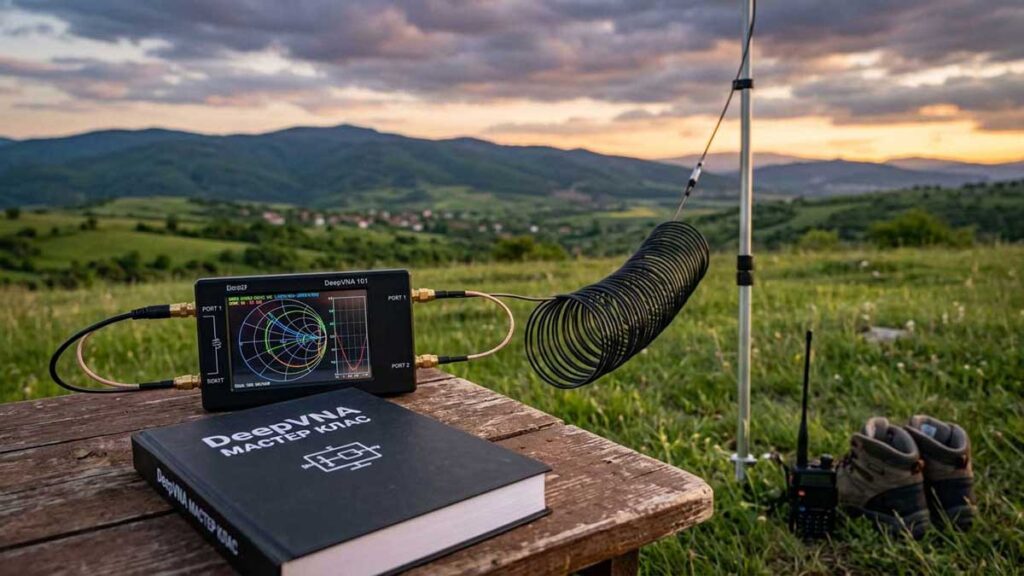
That’s how the idea for this book was born. After I was often asked how exactly I use my DeepVNA to tune JPC-12 or End-Fed antennas, I decided to turn my experience into a structured, practical guide. “DeepVNA Master Class” is not just a translation of the official operating instructions – it is a “Master Class” born from hundreds of measurements and practical experience in the field.
Who is this book for?
For beginners: If you have just bought a DeepVNA (NanoVNA or similar device) and are wondering what all those graphs it draws mean, this book will take you step by step in understandable language to learn them. You will learn why calibration is critical and how not to be “tricked” by your own device.
For advanced users: Here you will find details about the Smith chart (without unnecessary formulas), TDR diagnostics for finding defects in cables and how to use PC software (NanoVNA Saver) for precise tuning of multi-band antennas.
Key highlights in the “DeepVNA Master Class”
The language of the radio amateur: Forget complex mathematical formulas. Everything is explained simply, with clear examples from practice.
Practical scenarios: Tuning of dipoles, vertical antennas (like Rybakov), end-fed systems and filters.
Practical recipes: Specific data for popular antennas (coils and windings of JPC-12, lengths for End-Fed).
The Hidden Dangers: How to calibrate, where the power setting is located, and what to do if the touchscreen stops working.
PC Software: A quick guide to the NanoVNA Saver and how it helps with End-Fed antennas and other multiband antennas.
This book is the perfect complement to my previous FTDX10 and FTX-1F “Master Classes,” closing the loop between transceiver and antenna.
📥 Download the book in PDF format
You can download the full version of the book “FTX-1F MASTER CLASS Complete Guide to Filters, Audio Settings and Operational Mastery for the Yaesu FTX-1F Transceiver” completely free of charge from the link below:
👉 [Download PDF: DeepVNA 101/NanoVNA-F Master Class – LZ3AI]
Support the shared experience
“This guide is my contribution to the amateur radio community and will always be free to share. If you found the information in it useful and want to express your support for my work, you can buy me a cup of virtual coffee via the link below. Any such recognition motivates me to continue sharing practical advice and new ones on the site. Thank you and 73!” — Tony, LZ3AI
Buy me a coffee
Your feedback is important!
Amateur radio is a hobby of shared experience. Do you use different settings for your VNA? Do you have a “secret recipe” for easy and quick tuning of your antenna for field work?
I would be happy to share your opinions, corrections or personal settings in the comments below the article or over a coffee. Let’s make this guide even more useful for the amateur radio community!
73 and see you on the air!
Tony, LZ3AI
About the author (LZ3AI): “I am a passionate supporter of all things radio. I believe that sharing experiences is the foundation of the amateur radio movement. My “Master Classes” focus on the practical side of things to help you get the most out of your equipment.”