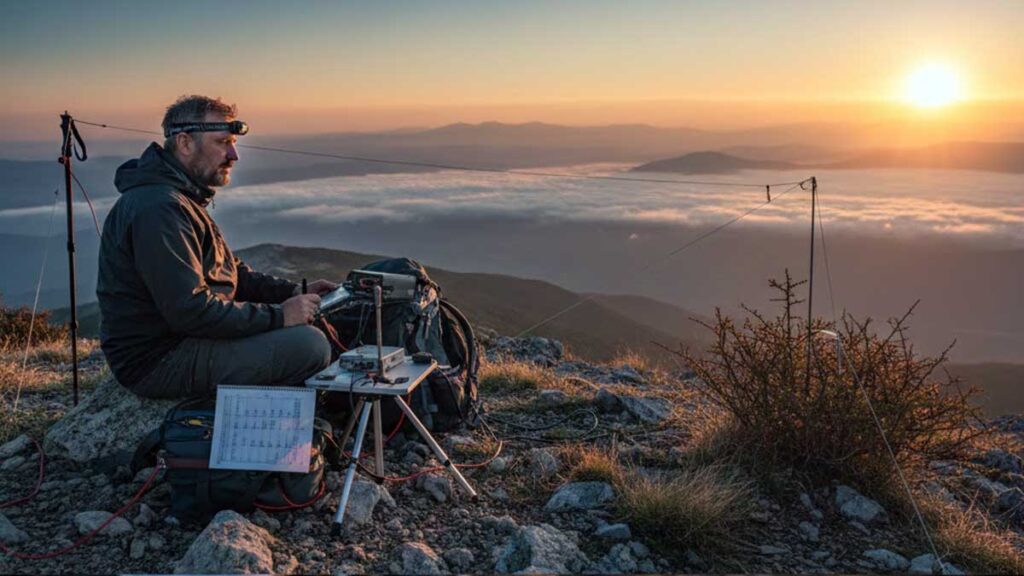
Frequencies, Antennas and a Little Stubbornness: Practical Amateur Radio Frequencies and Bands for Bulgaria
Have you ever opened the official band plan to check exactly where the center of activity was for SOTA/POTA, and after five minutes of reading sub-sections and definitions you forget why you turned on the station in the first place? Don’t worry, you’re not alone.
After dozens of attempts, drawing graphs (which look beautiful, but don’t work in the mud of field conditions) and versions that looked more like an accounting report than an amateur radio guide, I present to your attention… version 18.0 (or somewhere in between).
Why another table?
Because I’m tired of „too much info“. I had options with powers, classes, broadcast designations and administrative details in which you can get lost more easily than in the thick fog of Botev Peak.
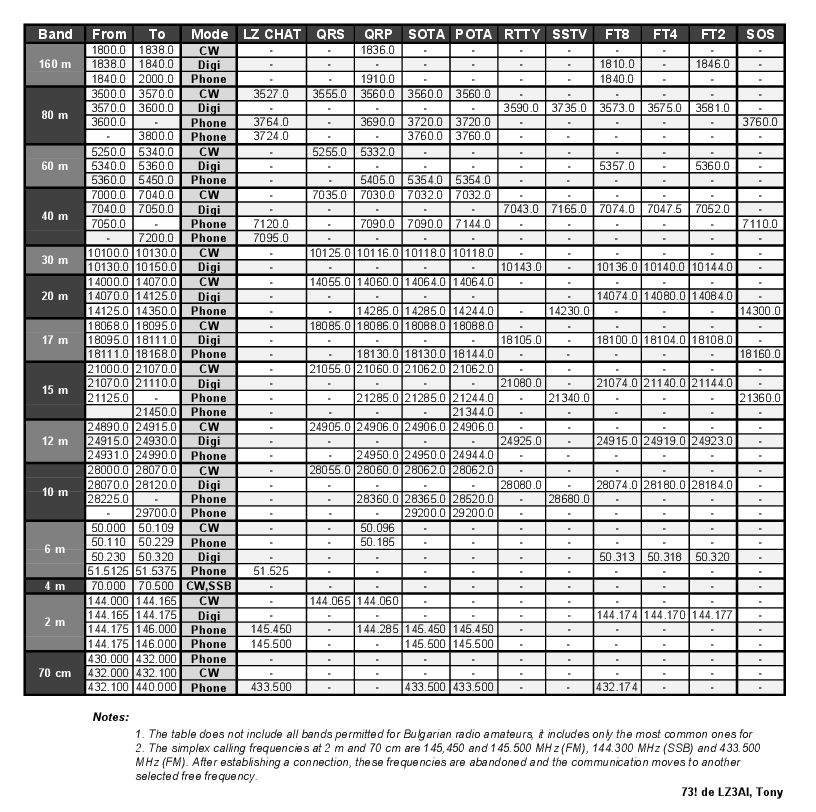
This table is intentionally incomplete. You won’t find everything in it, but you will find the most important. It was created with one and only one goal: to be a practical tool. I wanted it to have a practical and applied focus, without being some great scientific work.
What’s „under the hood“?
- Only the „live“ bands: I’ve focused on the frequencies where life is really boiling in Bulgaria.
- Operational accuracy: Where are the Bulgarians (LZ Chat), where are the activators (SOTA/POTA) and where to adjust your antenna so that the SWR doesn’t surprise you right in the middle of the call.
- The 60-meter bonus: The exact borders for Bulgaria are reflected (for example 5250–5450 kHz) – let’s know our rights (but don’t forget 100 watts for first class, nor how far are the powers of second class!).
- SOS section: Because in the mountains, safety comes first.
The „One Sheet of A4“ Format
The whole philosophy was to fit the table onto one sheet of A4. The idea is simple: print it out, laminate it and throw it in your backpack or stick it on the radio lid. It should withstand coffee, rain and the excitement of another DX.
Work in Progress
Amateur radio is a dynamic activity. This table is not „cast in concrete“. It is alive and will probably undergo further changes in motion while we use it in the field.
I also need your “report” (feedback): If you see a mistake, if a frequency has “escaped” or you think something important is missing – shoot me with comments and suggestions. I am open to any constructive comments (and a virtual coffee). Or at least a comment below.
Here is the table „Practical amateur radio frequencies and bands for Bulgaria in PDF format“.
As well as the link from which you can buy a coffee! 😉 Here!
 73 and see you on the air!
 73 and see you on the air!
Tony


3 коментара “Frequencies, antennas and a little stubbornness: Practical amateur radio frequencies and bands for Bulgaria”
From LZ3DA – Tony, the more common frequency for SOTA activation is 145450. I use 145500 often due to the pileup when more than one activation is going on. However at that frequency there is a Parrot somewhere in Romania which may interfere. At least if you are high enough to pick up a signal from . 73!
I will add the frequency when I have time. Thanks for the feedback! btw there is also a Bulgarian version of the site 😉
It’s already been corrected. Thanks again! 73!