
Using the telegraph key (Morse key)
Straight Key Grips and Sending Styles: The Art of CW Telegraphy
Operating a classic straight (manual) telegraph key requires proper wrist mechanics and ergonomic discipline. How an operator grips the key knob directly impacts sending rhythm, character proportion, and wrist strain during long operating sessions.
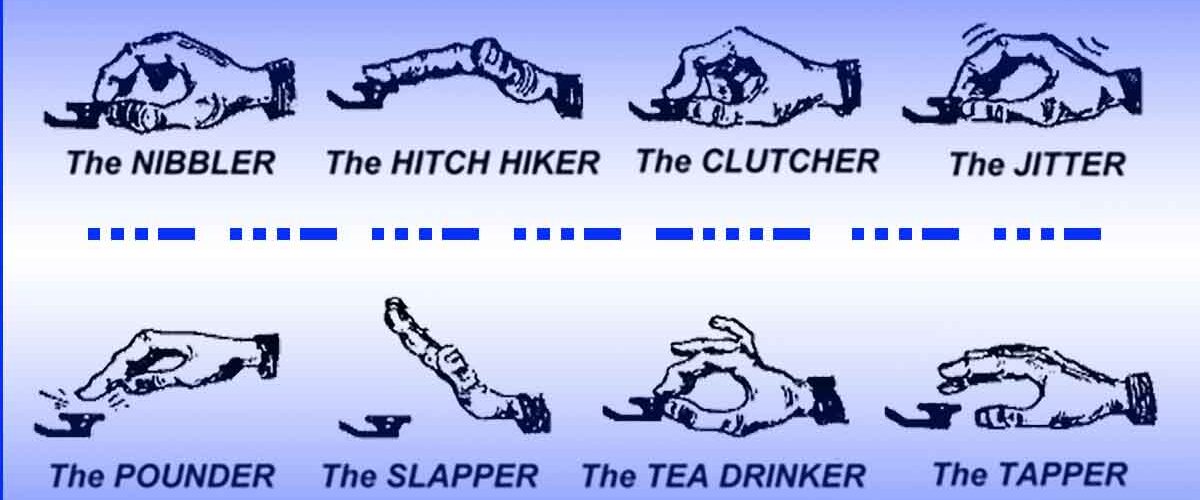
Over the decades, hams have coined humorous slang terms to describe unorthodox — and often physically improper — key grip techniques:
1. Slang Terms for Straight Key Grips
| Slang Term | Literal Translation | Description of Technique |
|---|---|---|
| Nibbler | Grip with fingertips | Holds the knob tightly using only the extreme tips of the fingers. |
| Hitch hiker | Thumb stick-out | Extends the thumb upward awkwardly while sending. |
| Clutcher | Full-hand clutcher | Grasps the entire knob rigidly, locking wrist flexibility. |
| Jitter | Tense operator | Sends with a tense, vibrating forearm muscles to achieve speed, sacrificing rhythm. |
| Pounder | Heavy pounder | Pounds the key heavily from the shoulder/elbow instead of pivoting from the wrist. |
| Slapper | Key slapper | Lifts fingers completely off the knob and slaps down on every stroke. |
| Tea drinker | Pinky-out grip | Extends the pinky finger outwards, resembling someone holding a teacup. |
| Taper | Refined operator | A relaxed, light grip using smooth, fluid wrist action. |
2. On-Air „Fist“ and Electronic Keyers
Every operator using a straight key develops a distinct personal rhythm, known in CW parlance as their „Fist“. Under heavy pileup conditions or heavy QRM, a unique fist can occasionally help a DX station pick your signal out of the noise. However, maintaining the standard 1:3 dot-to-dash timing ratio remains the gold standard for readable telegraphy.
Note on Electronic Keyers and Paddles:
These traditional straight key grip styles do not apply to automatic keyers (single-lever or iambic paddles). Paddles are operated using side-to-side squeezing motions between thumb and index finger, with precise dot-dash timing generated electronically.
These traditional straight key grip styles do not apply to automatic keyers (single-lever or iambic paddles). Paddles are operated using side-to-side squeezing motions between thumb and index finger, with precise dot-dash timing generated electronically.